
Bounce Light Canyon Photography: Reflected Light in the Southwest
Bounce light in Southwest canyons lasts for hours — not minutes. Here's how I read the conditions, meter on 4x5 film, and find the right moment in locations like Zion and Antelope Canyon.
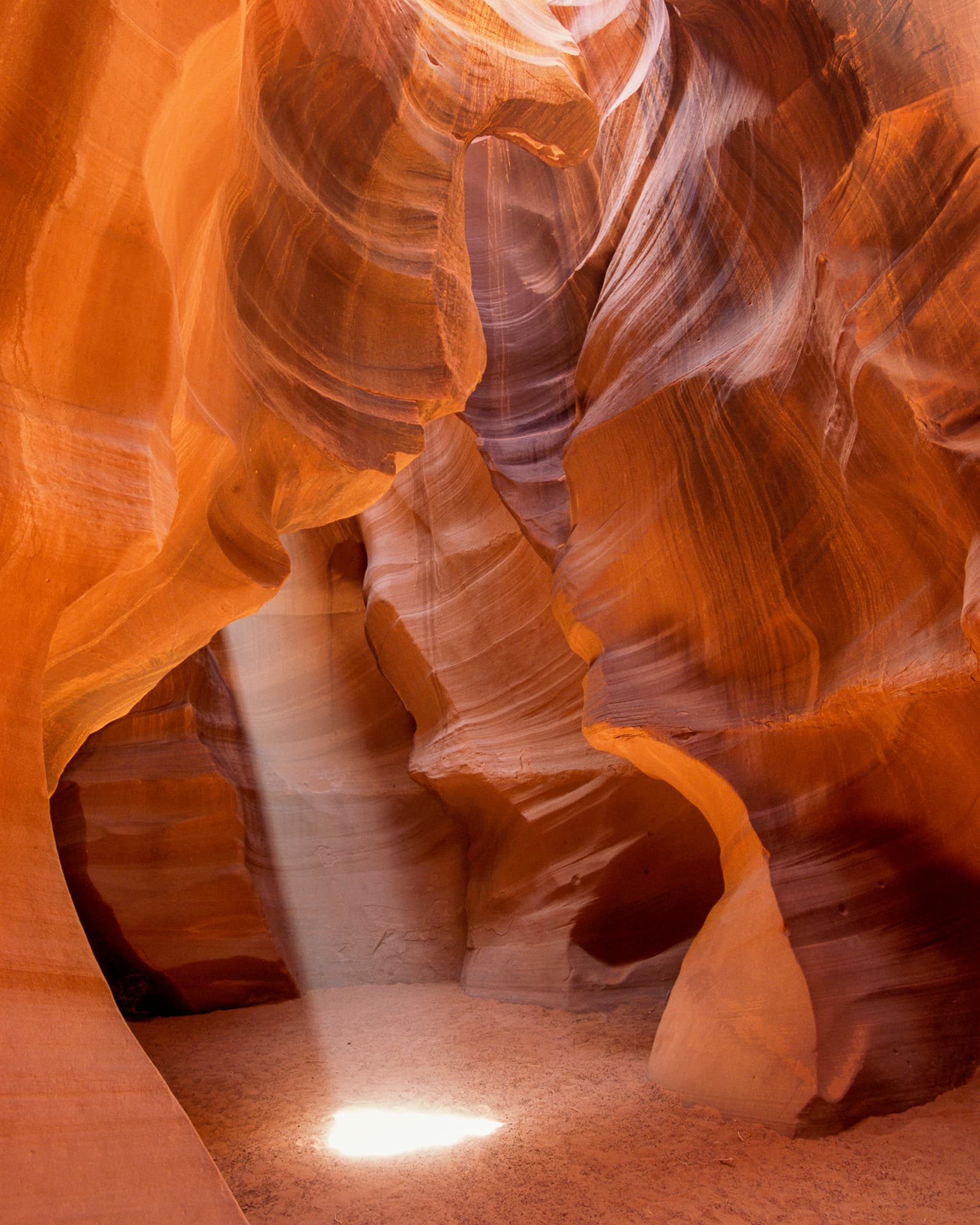
Most advice about canyon photography focuses on chasing light — getting there before sunrise, racing to set up before the golden hour fades. Bounce light works on a different schedule. In the slot canyons and deep gorges of the Southwest, reflected light can hold for hours. It's the condition I plan around most carefully, and the one that took me the longest to really understand.
How Canyon Bounce Light Actually Works
Bounce light is reflected light — sunlight that hits a canyon wall and redirects into the scene rather than illuminating it directly. The walls act as enormous natural reflectors, wrapping soft, warm light around rock formations and into shadowed recesses.
What makes Southwest canyons exceptional for this is the color of the walls. Red Navajo sandstone doesn't just reflect light — it transforms it. The bounce coming off those walls carries an orange warmth that saturates everything in the scene. At the same time, the open sky directly above supplies blue light to the deepest shadows. The warm/cool contrast between the orange reflected light and the blue shadow fill is what gives good canyon bounce light photographs their specific quality. It's not one light source — it's two, pulling in opposite directions chromatically.
One rule that holds across every canyon I've shot: no direct sunlight in the scene. The moment a shaft of direct sun enters your composition, the contrast goes extreme, the softness disappears, and the glow is gone. You're working with light that's as close to the scene as possible without actually hitting it. The closer the sun comes without entering, the stronger and more saturated the bounce.
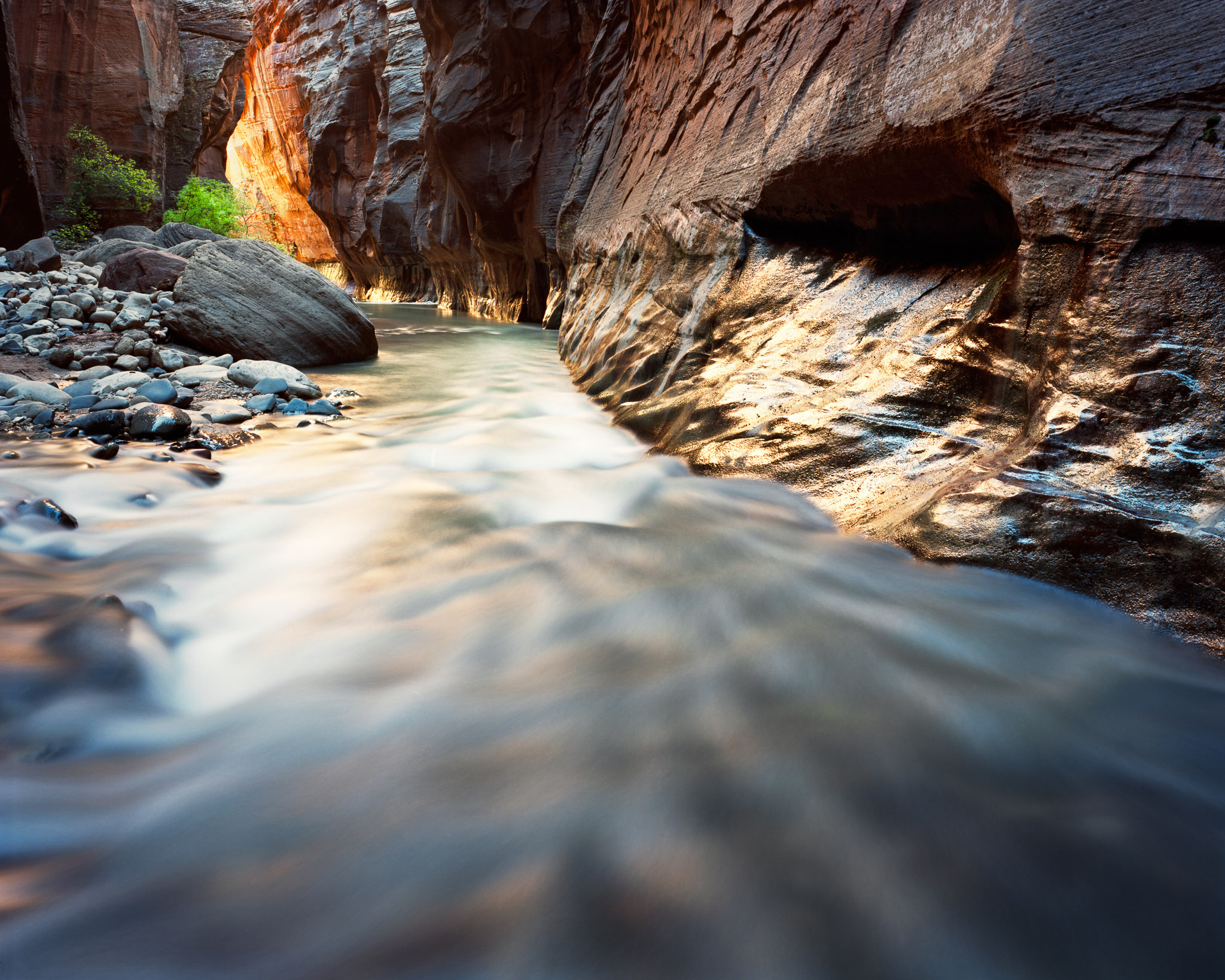
Zion Narrows — warm reflected light from the canyon walls. Shot on 4x5 large format film.
Reading the Conditions
Two variables determine whether bounce light is worth shooting on a given day: sky condition and sun position.
The sky has to be clear. No clouds. Direct, unfiltered sunlight hitting the canyon walls produces intense bounce. Cloud cover softens and weakens the source, and the quality of the reflected light drops with it. Partly cloudy is worse than either extreme — the light shifts constantly and you can't get a clean read on what you have. On overcast days in canyon country, I don't set up for bounce light.
Sun position is where the geometry gets specific. For any given canyon location, there's a window when the sun is positioned to send light at the right angle into the walls close to your scene. I use PhotoPills to model this before visiting — you can simulate the sun's path for any date and time at a specific GPS coordinate and see exactly when the geometry lines up. Getting to the right location at the right time is most of the planning. Once you're there and the conditions are good, the light usually holds.
Bounce Light Lasts — Use That
This is the part that changes how you work compared to almost any other type of canyon photography.
In Zion Canyon, the walls are several hundred feet high. Once the sun rises far enough to begin bouncing off the upper canyon walls, the reflected light on the canyon floor stays consistent for hours. On a good morning, one side of the canyon picks up strong bounce from mid-morning onward. As the sun moves, the bounce shifts to the opposite walls. You can work productively through most of the day.
Compare that to a sunrise shoot at an exposed overlook, where you have 15 minutes of usable light before the color disappears. Bounce light in a deep canyon doesn't work that way. The window is measured in hours, not minutes.
For 4x5 work, that changes everything. You can walk the location slowly, find a composition that actually works rather than the one closest to where you set down the pack, take time with the ground glass, bracket your exposures. The patience that large format requires stops being a liability. In good bounce light conditions, it's an advantage.
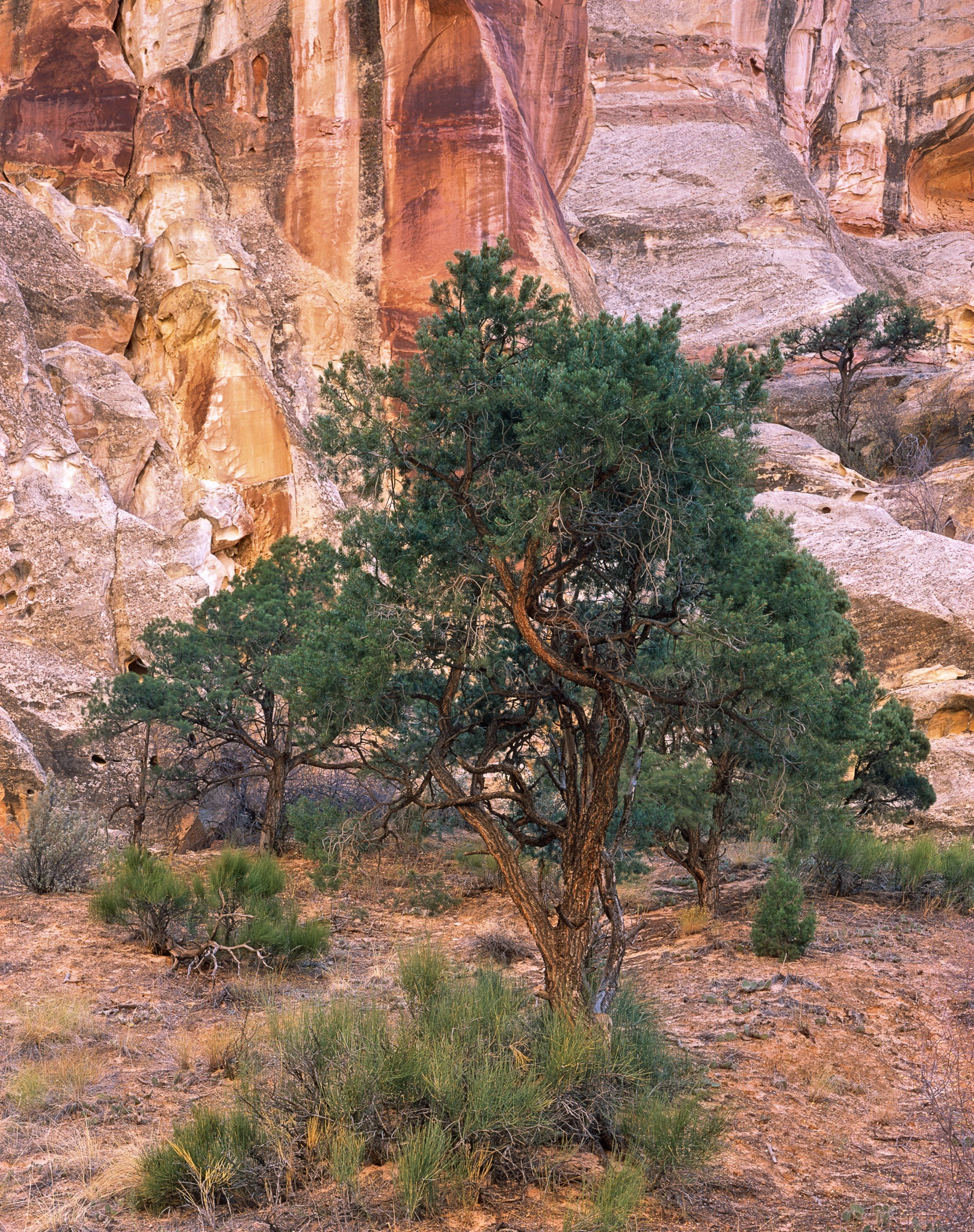
Pinyon pine in canyon bounce light. Shot on Velvia 50, which amplified the warm tones of the reflected sandstone light before Velvia was discontinued in 4x5 format.
Film in Bounce Light: Provia, T-Max, and the Loss of Velvia
The warm/cool contrast built into canyon bounce light has specific implications for film choice, and it's worth understanding before you load a holder.
On Kodak T-Max 100, color doesn't matter — contrast does. Bounce light in deep canyons is naturally lower contrast than direct sunlight, which can produce flat-looking negatives if you're not accounting for it. I lean toward developing for slightly higher contrast in bounce light conditions. The rock texture holds well on T-Max at these light levels, and the warm/cool separation translates into good tonal range in black and white.
Provia 100F requires attention to the blue shadows. Provia has a slight blue bias compared to some other transparency films, which means the shadow areas — where the open sky above is the primary light source — read bluer on film than they look to the eye in the field. The orange bounce versus blue sky-lit shadows is already a strong chromatic contrast; Provia amplifies it. That can work in your favor if you want to emphasize the contrast, but it can also push into territory that needs correcting in processing if the blues get too heavy.
Velvia 50 was exceptional for this type of light. The higher contrast and saturation amplified the orange-blue contrast dramatically — canyon bounce light on Velvia had a quality I haven't been able to fully reproduce since. Unfortunately, Velvia 50 in 4x5 sheet film format is no longer manufactured. Provia is what's available now, and it does the job well. Just know what you're getting with those blue shadows and decide in advance how much you want to keep or control in processing.
Metering for Reflected Light
Bounce light looks soft and even to the eye, but the dynamic range in a canyon scene is still significant. Bright lit wall areas and deep shadow recesses can be several stops apart in the same frame.
I use a Sekonic incident meter. I take readings from the brightest part of the scene and the darkest to understand the full range, then use those two readings to find a midpoint and adjust based on how much of the frame falls at each extreme. If bright wall areas dominate the composition, I pull back slightly from the middle reading to protect highlights. If the scene is mostly in deep shadow, I lean toward the shadow reading to hold detail in the darkest areas.
On transparency film: protect the highlights. Blown highlights on Provia don't recover in scanning. I'd rather have a slightly underexposed shadow area I can bring up than a wall section that's gone completely. Bracket in half-stop increments if you have enough holders — the metered reading plus a half-stop under is usually where I end up with Provia in canyon bounce light.
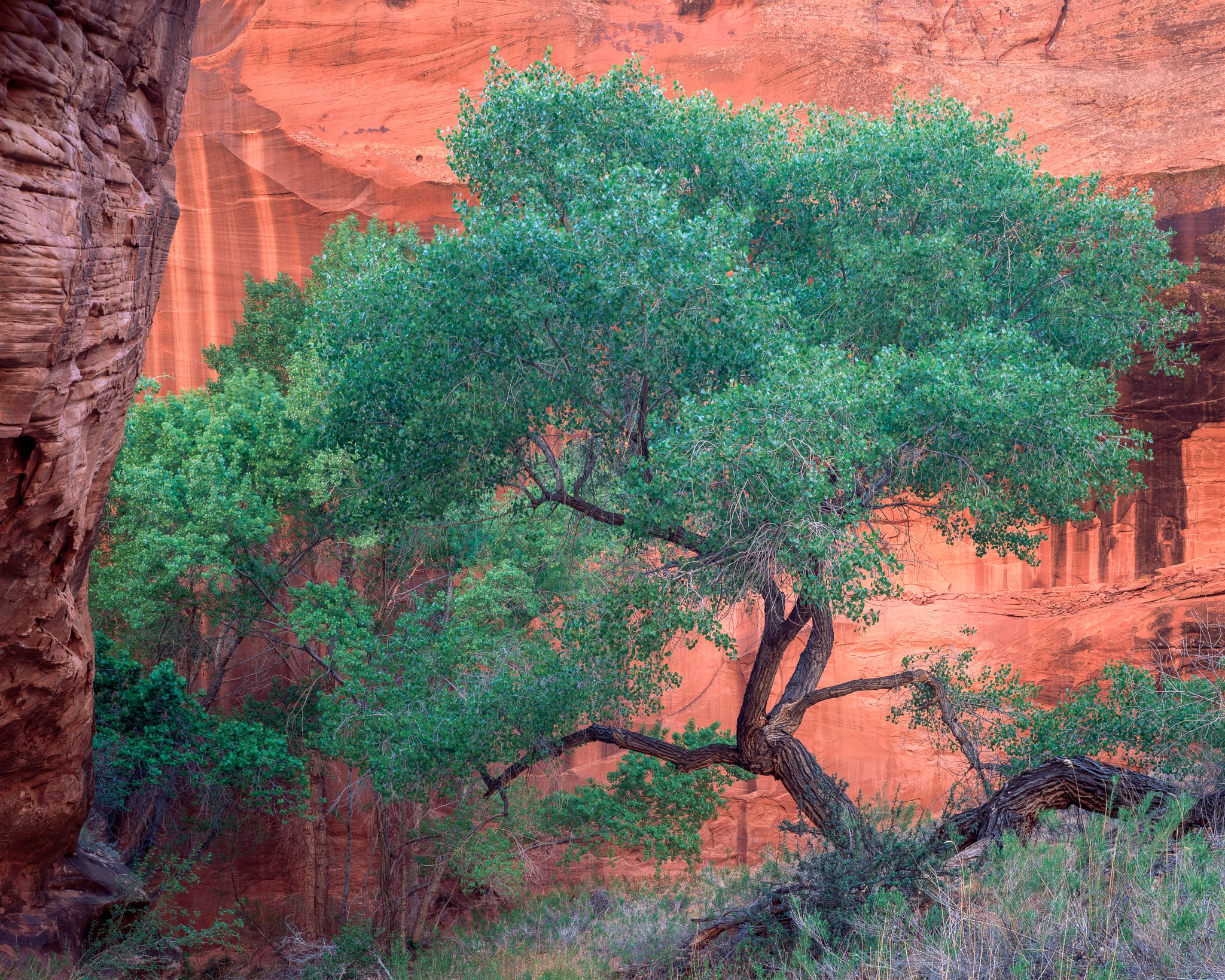
Crooked cottonwood in canyon bounce light. The warm reflected light from the surrounding walls gives the scene its color.
Best Locations for Canyon Bounce Light Photography
Zion Canyon, Utah
My personal preference for extended bounce light work. The canyon walls are several hundred feet tall — the scale is different from slot canyons — and the quality of light that fills the canyon floor in mid-morning is unlike anything else in the Southwest. Because the walls are so high, the bounce window lasts for hours. The River Walk trail at the base of the main canyon puts you in position for some of the best reflected light angles. The Narrows, further in, adds the Virgin River as a foreground element and keeps the walls close on both sides. Full location notes in my Zion photography guide.
Antelope Canyon, Arizona
The most well-known bounce light location in the Southwest. Both Upper and Lower Antelope have the right geometry — narrow sandstone walls, smooth surfaces, strong color. Upper Antelope gets the famous vertical light beams when the sun is overhead in summer; Lower is tighter, deeper, and less crowded. The crowds at Upper are significant — book a photography-specific tour if you want any control over timing and position. My full notes on both sections are in the Antelope Canyon photography guide.
Wahweap Hoodoos, Utah/Arizona
Undervisited and worth the effort to reach. The light-colored cream and white limestone formations reflect light differently than red sandstone — the bounce is cooler and more neutral. For color film, that means more accurate color rendition without the strong orange cast. For black and white, the formations have tremendous texture that the neutral bounce light shows well. See my Wahweap Hoodoos print for an example of how this light looks in practice.
Bryce Canyon, Utah
Bryce works on a different principle. The hoodoos and amphitheaters fill with reflected light from the surrounding orange and white limestone walls, particularly in the hour after sunrise and before sunset. The mixed white and orange formations create a more complex bounce than pure sandstone canyons. Exposure is trickier because the bright hoodoo tips can fool a meter when the lower sections are still deep in shadow — meter carefully and bracket.
Finding the right canyon at the right time comes down to preparation and patience. My guides on scouting locations for landscape photography and patience in landscape photography cover the approach in more detail.
Frequently Asked Questions
- What is bounce light in canyon photography?
- Bounce light is reflected sunlight — direct sun hits a canyon wall and redirects soft, colorful light into the scene rather than illuminating it directly. In Southwest sandstone canyons, the orange walls create warm reflected light while the open sky above fills shadows with blue light. That warm/cool contrast is what gives canyon bounce light photographs their distinctive quality.
- How long does bounce light last in a canyon?
- In a deep canyon like Zion, bounce light can last for hours — one wall picks up reflected light for several hours, then as the sun moves, the opposite wall takes over. This is very different from sunrise or sunset light, which may last 15 minutes. The long window makes bounce light ideal for large format film photography where setup takes time.
- What is the best film for canyon bounce light photography?
- Provia 100F is the current option for color transparency film in 4x5 format. Be aware that Provia's slight blue bias amplifies the blue shadows common in canyon bounce light conditions. Velvia 50 was exceptional for this type of light but is no longer manufactured in 4x5 sheet film. For black and white, Kodak T-Max 100 works well — develop for slightly higher contrast than usual since bounce light is naturally low-contrast.
- What settings should I use for bounce light in slot canyons?
- Use a tripod — exposures in shaded canyon environments run longer than in open landscapes. For aperture, f/11 to f/16 gives maximum depth of field. Meter the brightest and darkest areas of the scene separately, average the two readings, and adjust slightly based on which tones dominate your composition. On transparency film like Provia, protect highlights — err on the side of slight underexposure rather than risk blown walls.
Explore Related Photography
Enjoyed this article?
Subscribe for more photography stories, techniques, and exclusive behind-the-scenes content.
Related Posts
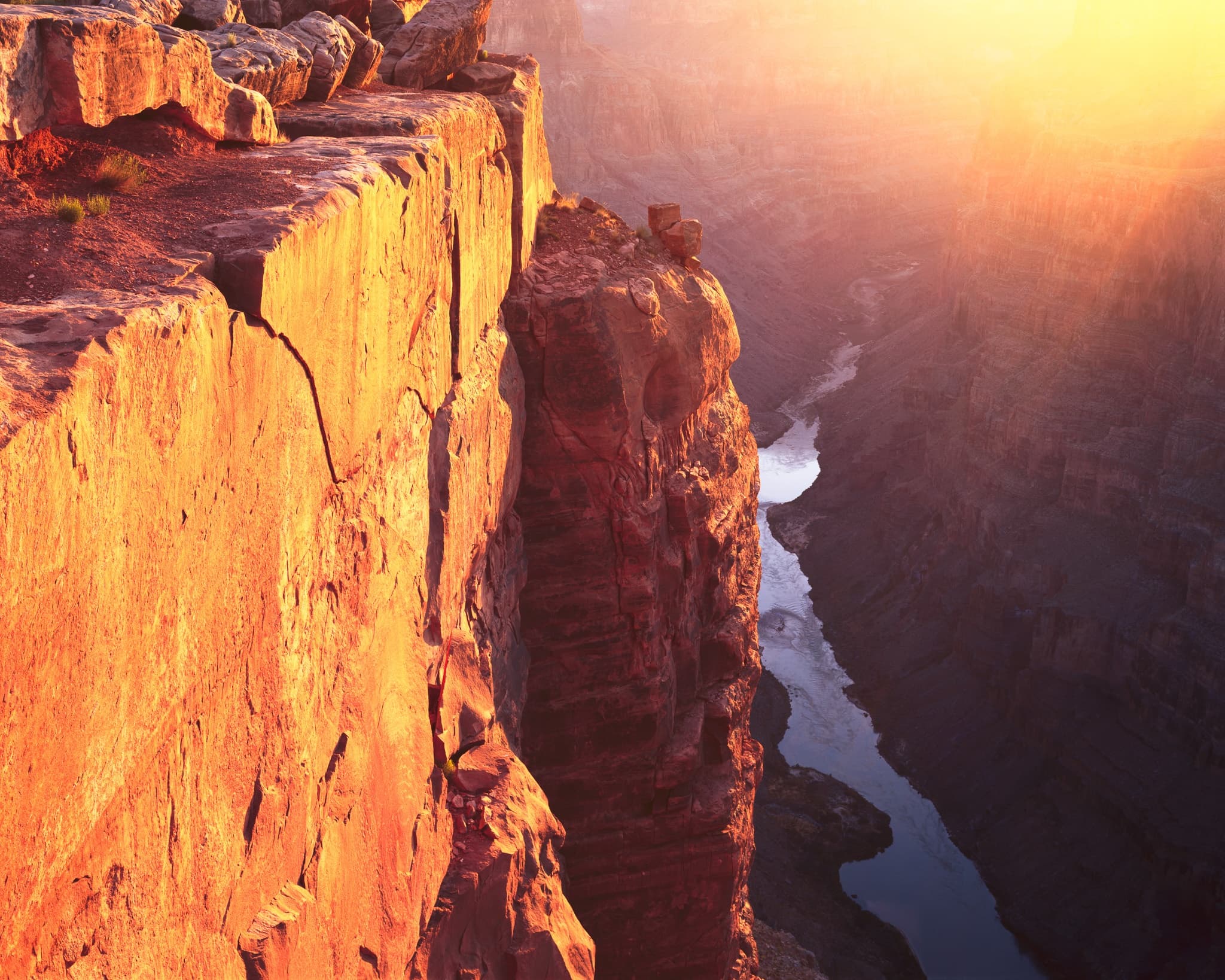
Grand Canyon Photography Guide: Best Spots, Light & Timing
The famous south rim overlooks are worth making. But the Grand Canyon images I keep coming back to came from a remote western overlook that requires 60 miles of unpaved road to reach — and from the North Rim in October, when the crowds are gone and the canyon light gets serious.
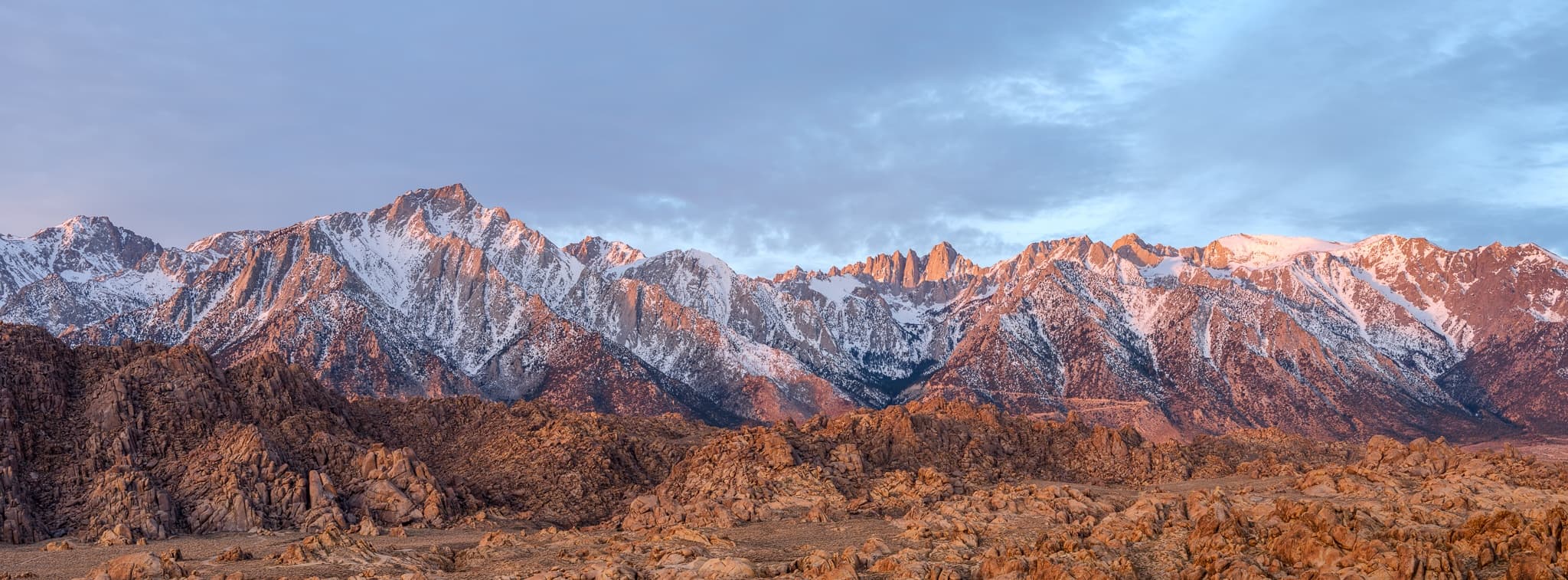
Best Places to Photograph Snow-Covered Mountains in Winter
Winter transforms mountain landscapes in ways no other season can. Where to go, when to go, and what to expect — from Yosemite's granite walls under fresh snow to Zion's red canyon in a storm.
Analog Landscape Photography: Why Film Still Makes Sense in 2026
Most photographers who've tried 4x5 large format film don't go back to digital for their serious landscape work. Here's the honest case for shooting analog in an era when you have no practical reason to.
Tags
Marty Quinn
Large format film photographer based in Phoenix, Arizona. Shoots on 4x5 Arca-Swiss view cameras across the American Southwest — Utah, Arizona, Death Valley, and the Colorado mountains. 25+ years behind the lens. Published in Outdoor Photographer magazine (The Last Frame, June 2008). About Marty →